Start with the team, not the talent.
For a kid landing in a new country, the fastest way to belong isn’t a language class, it’s a team. Heritier came to Moncton speaking Swahili and Lingala, not French or English, and soccer is where he made his first friends and integrated quickest. Practices and games force you to work and talk with each other, so a new kid is part of something before they can even explain themselves. Sign up first. The rest follows.
Don’t let the cost stop you.
There is a cost to organized soccer, and it goes up with the level you want to play. But Heritier’s whole message is that money is rarely the real barrier in this region. A lot of associations and organizations help reduce fees, or cover them entirely. His own family was carried by the community when they arrived, drives to practice and games, food, help finding somewhere to stay, fees handled. The mistake is staying quiet. The move is to ask.
- Ask the club directly. Some clubs run programs specifically for newcomer families, often aimed at helping the parents understand how the system works.
- Ask about fee assistance. If the registration cost is the problem, say so. There are people and organizations whose whole purpose is to make sure a kid can still play.
- Lean on the community. Rides, gear, and a hand getting to games are the kind of help neighbours give all the time here. It’s how Heritier’s family got through.
Where to start looking.
Soccer New Brunswick is the place to begin, their website lists programs, clubs, and events across the province. In greater Moncton, Soccer Dieppe is one of the local clubs. And if you want a softer first step than a league, watch for community tournaments: the Tournoi Amical de Moncton (TAM) brings together teams from around the world, Senegal, Ivory Coast, Canada, the Acadian community, and more, with stands, food, and music. It’s a community league, and a good way to feel the game before you commit to a season.
The mindset to pack.
- Expect to be underestimated, and outwork it. Coming from a smaller province, Heritier tells young players they’ll have to work two or three times harder than the kid beside them just to be seen. Take the risk anyway.
- Fail at home so it’s easy on the field. He failed constantly in the backyard, broken windows and all, until juggling anything looked effortless. The reps nobody sees are the ones that count.
- Have fun. “Make sure you’re not scared to fail, and enjoy yourself.” That’s the whole point.
There’s a place in the game for whatever you’ve studied.
Soccer isn’t only for the eleven players on the field. Heritier calls the rest le travail invisible, the invisible work: nutritionists, mental-performance staff, the people behind the scenes. If you’ve studied psychology, nutrition, even criminology, like he did, there’s a role for you in the game. The ecosystem is large. Parents and adults don’t have to play to belong to it.
A big summer for the game here.
The 2026 World Cup, co-hosted by Canada, the United States, and Mexico, opens June 11. There are no matches in Moncton, but the city is leaning in: Soccer NB has events planned, including a full day downtown at the Avenir Centre on June 18, and the city plans to broadcast some games. Check Soccer NB’s website for details. It’s a good moment to get a kid excited, and to picture what it would mean for Moncton to one day have a professional team of its own.
The conversation
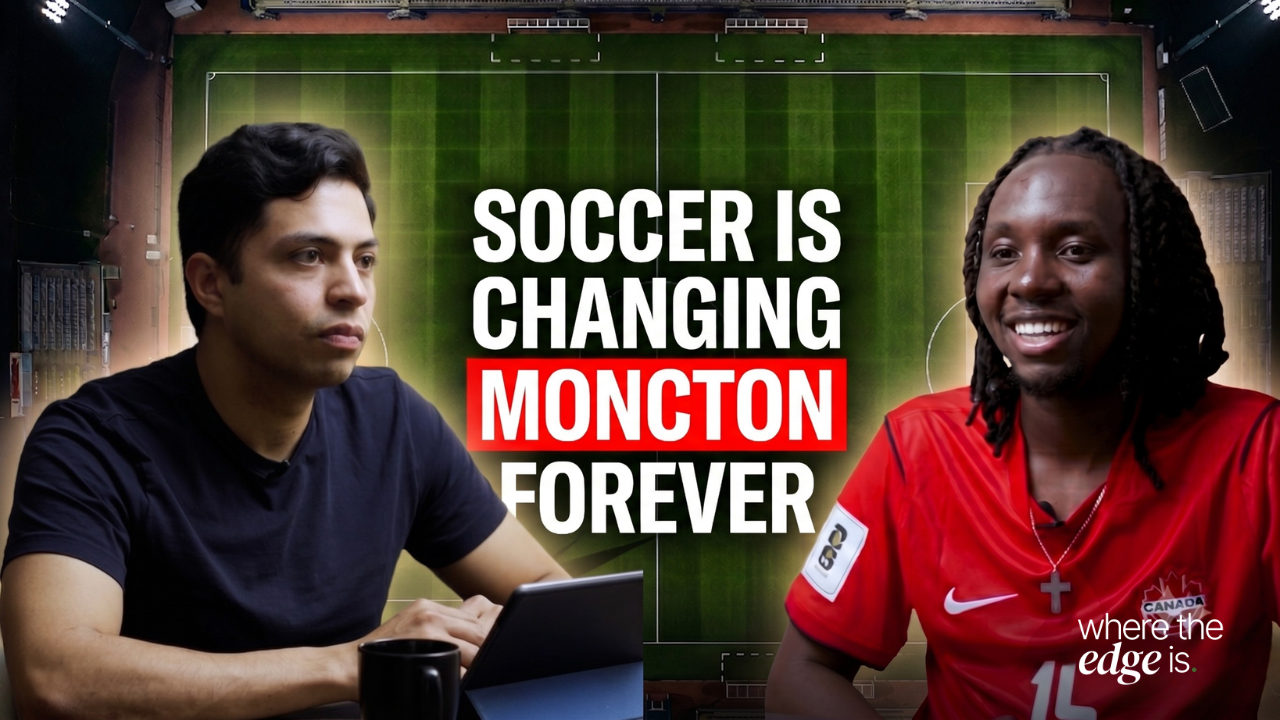
This field guide sits alongside Episode 02 of Where The Edge Is. For the full conversation with Heritier, his family’s journey from Goma, the resilience he sees in Canada’s national team, and what the Acadian story has in common with his own, watch How soccer turns newcomers into neighbours.
About Heritier
Heritier Masimengo is the East Region Director with Soccer New Brunswick, an executive board member at Soccer Dieppe, and sits on Canada Soccer’s national review body. He came to Moncton as a child after his family fled the war in Goma, and played for the Université de Moncton.
Production
Where The Edge Is is produced in Moncton by LIF Media, a video and storytelling studio that helps people across the Maritimes tell their stories. If you have a business or a story worth telling, you can find them at lifmedia.ca.
Know someone who should be on the show? Tell us about them →